
Ritika stands at a powerful 5’2 with shiny long, sleek black hair. She has a full smile that spreads to the corners of her eyes and a laugh that is contagious.
Today, though, something is different. Ritika settles in at her shift as a Barista as usual, and performs her tasks dutifully and conscientiously, but her smile might not fully reach her eyes, and a weight of listlessness and trepidation hangs in the air.
Only just a few days prior, a customer had come into her place of work, ordered a coffee, and proceeded to throw a racially-fuelled tantrum, targeting each non-white employee one by one.
When I’d asked her what happened, she said, “I asked for his coffee preference [and] instead of answering my question, he launched into a tirade against me and my coworker.” The coworker standing next to her being another immigrant of Kenyan descent.
What began as nonsensical mumblings to himself, slowly evolved from latent, implicit xenophobia, to a much more direct eruption. “Africa here! India there!” He began. He looked at Ritika’s coworker, a young adult from Kenya, and asked her, plainly, “Why are you here?” When she asked him what meant, he clarified, “Why are you here if you’re from Africa?” When another coworker noticed the possibility of escalation, she butted in and asked him where he was from. He proudly and imperiously beat his chest and exclaimed, “Me? I’m a Canadian!”
He seemed even more so upset that they were serving him ‘Canadian coffee,’ even though the coffee was sourced from Ethiopia and Latin America. He then demanded that Ritika and her coworker leave “his country,” using instigative remarks like “you brown people.” He did all this, while still expecting Ritika to politely serve him his beverage.
This outburst, which was witnessed by many others, including passive observing customers, caused a great stir that left many feeling bewildered and shocked as to what led to this man’s outpouring. Later on, to make light of the situation, a regular at the establishment would go on to comment that, “He must have forgotten to take his meds.” We laughed uncomfortably and disdainfully shook our heads at the absurdity of the situation, but the unsettling feeling and the pressing why remained.
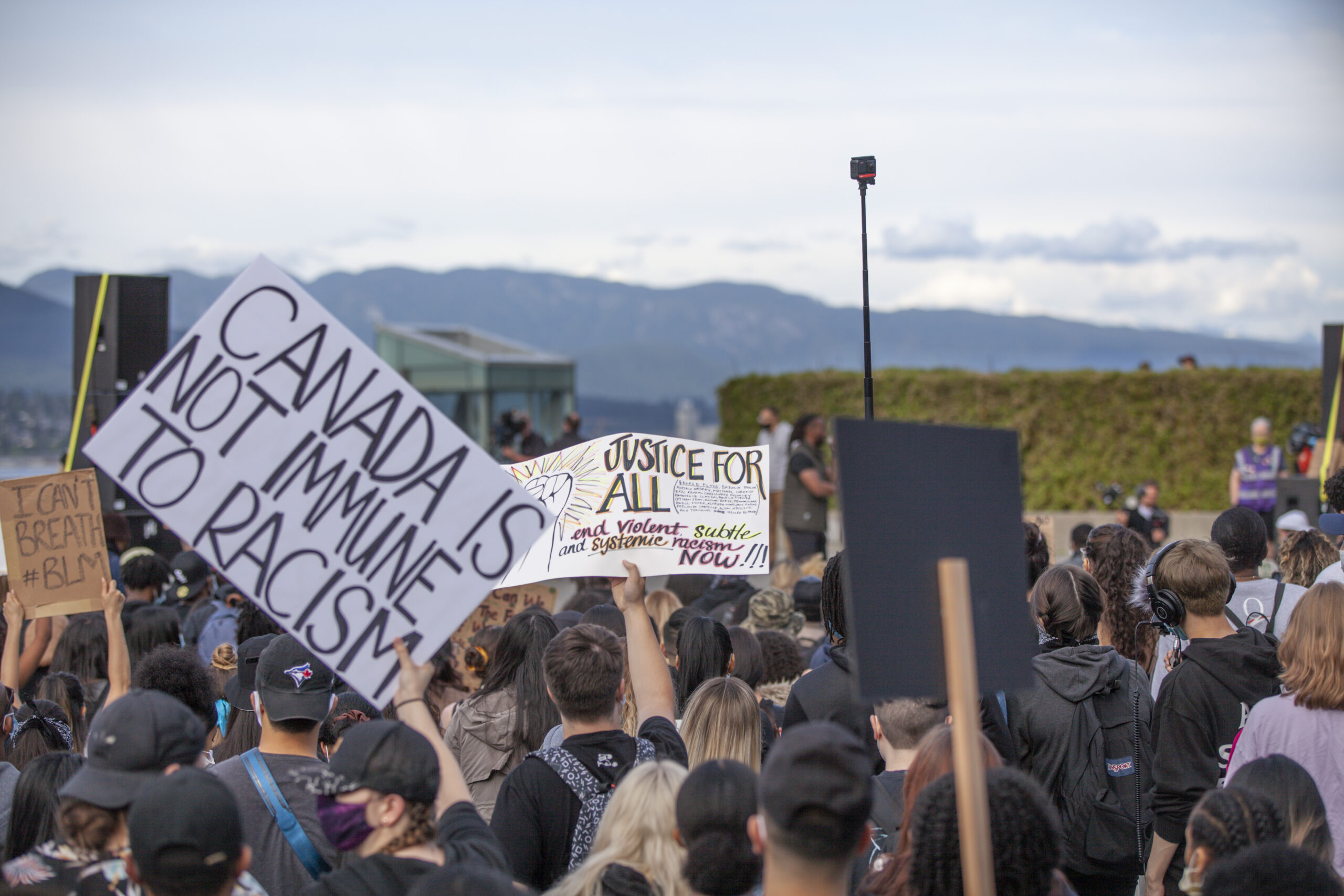
As of 2025, hate crimes against South Asians in Canada are up at least 83 per cent. While this is a startling statistic, it is important to note that like all racism and bigotry, hatred against South Asians in Canada has always ebbed and flowed while seeing a steady linear climb over the years. With the current political climate, and the worrying rate at which racism against South Asians in particular is normalized, it seems to be seeing a current resurgence that is uniquely met with very little resistance this time around, even in the most mainstream of circles and media.
It’s evident that this issue mainly originated from mounting, unabashed and unrestrained contempt. But this time around, something feels different.
Canada has used immigration as a tool to counteract its ageing population- and the strain that it is having on the economy- for decades. Around two thirds of immigrants influxing the country in recent years are of prime working age, which is said to bring equilibrium to the workforce and help ease the general economic struggles that come with an ageing population in the process.
Canada’s immigration policy, which prioritized long-term economic growth above all, aimed to bring in as many as almost half a million permanent residents in 2023 alone. This plan, many came to learn, would be ill-advised because of Canada’s imminent infrastructure deficit. To put it plainly, the government bit off more than it could chew, with the country being unable to maintain the level of economic activities and social services necessary for its current population. This is evident in Canada’s housing affordability crisis, where the number of people in population dense areas exceed the number of houses available. People watch helplessly as resources seemingly grow scarce, opportunities become slimmer, and as a seller’s and employer’s market arises, mainly due to demand exceeding supply.
As aforementioned, this form of economic instability and nationalism followed by intense hatred is not new. In 1872, British Columbia’s Qualification and Registration of Voters Act banned Chinese Canadians and Indigenous people from voting. The reasoning behind this was simply to “safeguard political and economic power among white residents.”
Just as recently as 1907, another amendment would be passed to bar South Asian Canadians from voting in provincial elections. They would only be granted the right to vote in Canadian elections in 1948. The Canadian government underwent all kinds of methods to discourage Asian immigration and Asian residents from existing freely in the country. This ranged from taxes they doubled specifically for Asians migrating into the country, to restricting Asian Canadians from access to housing and job opportunities in the late 19th and early 20th centuries.
By the 1970s, hatred against South Asian labourers from commonwealth countries was easily accompanied with brutal beatings and assault, and deemed as just and appropriate mainly because there were no cameras to film it. In the early 2000s, “the most common types of hate crime violations included mischief or vandalism (29%), assault (25%), uttering threats (20%), and [more],” with South Asians being one of the most frequently targeted outgroups. Around this time, Indian IT worker stereotypes emerged as Indians were increasingly accused of stealing jobs in tech workspaces. With all of these displays of aggression on the rise, Canada was still able to save face as a country. The issue never reached that of true international significance, the way other countries may be known for their brazen displays of anti-Asian hate.
It seems the biggest difference now, is that as Canada sheds its previously crowned diplomatic and diverse title, it does so with pride. Today, no amount of cameras and outlandish racist outbursts being filmed by unsuspecting immigrants will make the average emboldened bigot see eye to eye with a fellow human. There is no more shame in the dropping of the facade, the pretense of benevolence.
A few things have remained constant in this bigotry, if not worsened. The incessant need to conserve the economic and political power of white Canadians against all other interests has spiralled into dangerous rhetoric and moral panics that are perpetuated as a means to fear monger the average middle to below class white Canadian.
The replacement theory, which is a far-right extremist ideology, exacerbates these fears. It upholds the notion that the mere existence of nonwhite immigrants taking up space in white majority countries threatens the well-being and freedom of whites. This ideology, once mainly associated with extremism in the United States and select European countries, has since spread rapidly amongst Canadian nationalists as well, reaching the mainstream and being celebrated as the default way to view non white immigrants. This same sentiment, as commonly observed, rarely extends to white immigrants, as concepts of perceived ‘purity,’ entrenched in racial and cultural stereotypes will commonly exempt white ethnicities from aggressive judgement.
This notion relies heavily on the belief that a South Asian’s pursuit for a better life directly impinges on what should be considered a “pure” Canadian’s birthright. This extremist lie that one group is co-conspiring against the other to overthrow the white race and surpass them in all areas of life is an insular way of thinking. It only furthers enough division needed to distract Canadians from the oligopoly the country is becoming.
This same lie is often perpetuated by political party candidates who promise to reduce the prices of commodities and groceries. To cut down immigration which will in turn instantaneously result in a better life for white Canadians for glib reasons that are not properly delved into. Unfortunately, the population buys it. Instead of questioning the glaring monopoly issue the country is facing, or finding other ways to circumvent unadulterated and misdirected hatred at an obvious scapegoat. Despite the original settlers of this land being exposed to high levels of disenfranchisement, many Canadians will often jump to long winded conclusions about what is fair, right and just for “true Canadians.” They often do so with little to no political literacy about how their country is run on its different levels of government. Then lazily point to immigration as the sole cause of Canada’s many crises without taking a deeper look into the country’s pre-existing issues, population densities and infrastructures.
The context of the South Asian community’s history in Canada explains why some of them might be untrustworthy of the Canadian government and its supposed resources. Why many turned inwards and sought out connections in their communities to help uplift each other in a country that is brazen in its unabashed hatred for outgroups.
Shah is a Post-grad immigrant from Bangladesh who, like Ritika, worked in the food industry. Upon arriving in the country, he experienced explicit racism from a coworker at the first restaurant he worked at in a growing city just outside of Toronto. “Since I was new [and learning], he didn’t miss any chance to make a racist remark every time I made a mistake,” he said about his coworker, who would mutter slurs under his breath whenever Shah had a question.

Nationalists and those who bought into tribalism politics alike often believe in denying people regular humane treatment because of their heritage. They rebuke family reunification or the general pursuit of a greater quality of life as it concerns Brown immigrants. It is sentiments like these that caused that customer to proudly beat his chest as he declared himself a Canadian. Although, to point to him that even the purest of Canadians trace back to migration as well would lead to a screaming match of who is deserving of what, who was there first, and other tirades fuelled with whataboutism.
Simply put, this form of bigotry rarely rebukes an immigrant’s pursuit of a better life so long as the colour of their skin is not a few shades too dark, or the mere presence and perceived implications of their culture don’t seem too threatening, unpalatable or perverse. There may be discomfort surrounding certain White immigrants for not being “the right kind of white,” but we rarely hear of this kind of hatred and vitriol concerning them because at least the gulf between cultures isn’t perceived as one that is vast. The chasm isn’t seen as too deep because at least white skin compensates for much of the paranoia, moral panics and fear mongering politics regarding cultural differences.
According to the Royal Canadian Mountain Police, “East and Southeast Asian populations experienced a 293% year-over-year increase [in hate crimes] between 2019 and 2020.” This is the starkest increase within a specific racial group the country has seen in years.
Many demagogues have also been recently known to push their rhetoric by emphasizing white majority numbers dwindling due to lower fertility rates.
While many Canadians fear that their place or ability to climb the social status ladder will be wrongfully stolen by an undeserving migrant, not all believe this. In fact, there exists a correlation between foreigners and the immediate presumption that they are assumed to be ‘low skilled’- and therefore deserving of, and assigned to only low or no wages- which often leads to worker abuse and exploitation as we know of.
The climate of rage in Canadian society has wholly normalized and casually accepted South Asian hate. Oftentimes downplaying it, turning it into a punchline, dismissing it with a shrug of the shoulders or a silent agreement. Similarly to the customer who casually and flippantly said, “he must have forgotten to take his meds.” Its dismissal exists even in the face of shock and unadulterated disturbance. Many Canadians have reached a point of no return where they will sycophantically reject the diverse, tolerant and diplomatic stereotype.
However, some things still stay the same. That man walked into an establishment and saw what he considered to be one too many employed Brown people, and felt his status, economic standing and stability threatened as a result. Much like earlier laws and restrictions that prohibited Asians from having access to any semblance of power. Anyone who has studied the cycle of history long enough knows that “unjust discrimination often gets worse, not better, with time” (Harari, 2014, p. 161).
When asked what he misses about Bangladesh, Shah admits that despite his improved quality of life and overall health in Canada, there is a level of community that can’t be beat. “I miss the food, man. Food and my family are the two things I miss the most… Going out with your friends, playing morning football on the weekends or [Family] get-togethers on big occasions… I am a Muslim [and Eid] isn’t the same as back home.”

When Canadians complain about the general cost of living, scarce, or unforgiving jobs, they are immediately met with retorts blaming them for “voting to let millions of immigrants come here.” Or more famously reminded that there are millions of people from Asia or Central America who will happily take our jobs that we are so unhappy with. To some degree, it may hold some truth. But it’s easy to make a sweeping generalization. It’s much easier to refuse to humanize and to instead debase immigrants to the lowest entry level jobs, while still expressing contempt when they work the jobs that people otherwise regard with such little esteem.
Most of the people expressing anger over these sentiments seldom mean to include white immigrants- the ones from England, Poland, or even Ireland. They don’t assume that these types of immigrants take up as much space as, or will be as demanding as their non-white counterparts. They don’t see the courage, struggle and even pain it may have taken to leave a world of culture and community behind.
These racist cultural myths and ideas of purity have a long and rich background in Canada. As Western communities become more insular and individualistic, many South Asians try to conserve one of the many beautiful aspects of their cultures by injecting community and edification of each other whenever possible. In a country that was always concerned with its economy and image, without taking the real measures to ensure infrastructure for the immigrants it claimed to care about, it is only reasonable to hope that South Asian communities are able to continue coming together to lift each other up in the face of resistance.