
Meritocracy is dead. It has been for a while.
People are working harder than ever before, living below their means, and still living pay cheque to pay cheque.
Oftentimes, those who are within a higher tax bracket tend to respond to this crisis in a way that is more than tone deaf. They muse that if we just worked hard enough, lived a life of monotony, below our means- or magically found a way to bump our salaries to 100s of thousands- focused on retirement, instead of being so hedonistic and indulgent now, we would reap the fruits of our labour… eventually. People are either advised to live like this, or to “beat the odds through crypto,” or the trite and doubly unhelpful advice to “just start a business.”
It reminds me of an equally thoughtless take on how ignorant westerners often regard poorer children from developing countries. “Look at that kid! He has so little and yet is so happy!” quoted next to a photograph of a severely underweight and malnourished adolescent, who has been asked to pose for a picture by a voluntourist with a white saviour complex. As if they understand the intricacies of the hardships that child must face on a day to day basis. As if that child has a tangible idea of the extent of disparity that exists in the world, and how much better life could be. These people tell us that we are not working hard enough, or that if we are, we are not grateful enough.
Until recently, there seemed to be a collective optimism about the future, but many parts of the world have continuously shifted towards monopolies, oligarchies, plutocracies and even gerontocracies, where much of the wealth we see being concentrated is greedily withheld and hoarded. This is becoming especially true in countries like Canada and the U.S.
Largely, conservatives have lauded this idealized notion of capitalism, and have impetuously put their trust in the fiscal responsibility of conservative governments. The divide between the rich, or those who benefited from the status quo, and the poor, is often deemed as necessary in a world where healthy economic competition is prioritised above all. But this competition is beginning to be a thing of the past, once again with many monopolies rising to a level of unchallenged and indomitable power.

If we reject abundance and adopt this lifestyle as our new reality; a life mainly devoid of decadence and real enjoyment, and slap on euphemisms like minimalism or “simple living,” maybe the struggle will finally be worth it. We have seen this formula of restricted living all too often fail, and lead to a life of deep existentialism, depression and burnout.
As the working class struggles increasingly to keep afloat, these issues have become more difficult to ignore. It is simply no longer about how frugal or economical we are. About how much work experience, how many accolades, achievements or higher levels of education one might have that matter. As the job market becomes more saturated with searchers than ever before, with hundreds of people flocking to applications at breakneck speeds, cronyism has become an easy copout for employers and hiring managers. It’s an easier route than sifting through what seems like an infinite number of cover letters and resumes during an expensive process that could result in an unsavoury hire. Even worse, cronyism has become a significant barrier for progress in businesses and the economy, as truly hard working or even qualified candidates are often rejected and left to burn out in a gruelling job hunt.
It is about who you know, and in more extreme yet shockingly common cases, it’s about being born directly into wealth and opportunity.
This also does not take into account the prevalence of fake jobs, or entry-level jobs requiring several years of experience. This then perpetuates the fallacy of the skills gap; a myth that is present in a market favourable for employers, where expectations are raised precipitously to ward off imperfect or “unqualified” candidates. Employers understand that this is an unstable time for job searchers and the economy, and can easily extort this desperation by incorporating the role of several people into a single person role for half the pay. It’s easy to forgo a healthy work-life balance and succumb to a 7 day work week when you have bills to pay and have reached month 7 of the job search. There also exists the calculated and premeditated practice of making an employee desperate enough to accept lesser perks after they have been wrung through a mentally fatiguing multiple round interview process- a phenomenon that wasn’t as widespread until recently. This causes them to act quickly, paying into the sunk cost fallacy because one has devoted so much time to one employer, and because they need to eat. The increased practice of companies using AI Software like hirevue to score interviews instead of relying on human decision-making means we’re now dealing with the added challenge of automated discrimination in the job search.
Fewer opportunities for the general public does not just mean more dissatisfied citizens, but hungrier mouths and bigger wealth gaps. Studies show that countries with a higher wealth disparity between the rich and poor contribute to lower qualities of life all around, for everyone involved. Take, for example, South Africa, a country which has been known to carry amongst the largest levels of wealth inequality in the world, with added hindrances for opportunity when it comes to racial and gendered inequality. Between 1993 and 2017, “the top 0.01 percent (about 3,500 adults) own[ed] a higher share of wealth than the bottom 90 percent as a whole (about 32 million individuals)… [This evidence shows] no sign of decreasing wealth inequality since apartheid.. [It may have] even slightly increased.” Though not as glaring as South Africa, an unsurprising parallel of racial inequality can also be observed in the U.S., with Black college graduates statistically earning a lower net worth than White households where the earner is a dropout. This only validates the notion that level of skill or education simply no longer suffices in many cases.
When comparing a country like South Africa to Norway, known conversely as a country with one of the lowest levels of wealth inequality, the quality of life boasts a stark contrast. Although one can argue that Norway hosts a significantly smaller population, the general quality of life in the country seems to be far better for other reasons that can’t be ignored. This is because countries that are committed to fighting wealth disparity are often committed to fighting other levels of inequality, which can be observed in its healthcare, job satisfaction and work-life balance, lifestyle and economy.
With poverty comes corruption. And it is obstacles like this that point to why child poverty in Canada is growing. Parents can’t afford to put their children in higher education, or may live in neighbourhoods without access to quality education. This perpetuates the custom of having to move out before one is ready, leading to a life of severe inconvenience as one struggles to find their footing in an increasingly expensive world with (starting) wages that don’t match. Chain reactions like this simply resulting from a child who dared to be born into a slightly less fortunate or connected family.
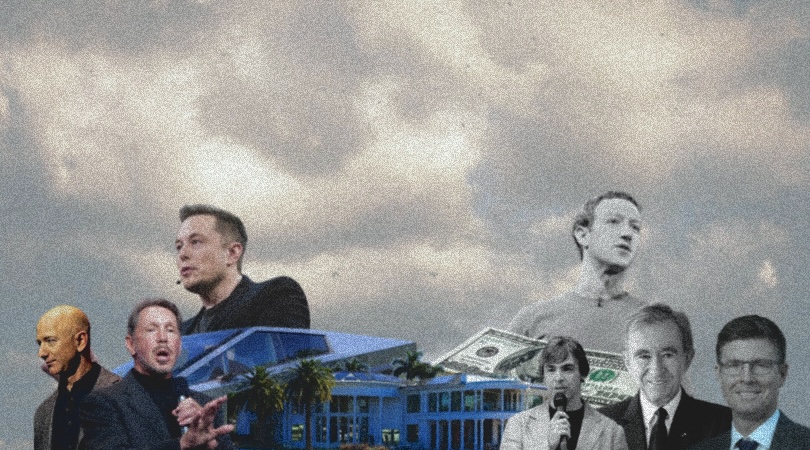
Today’s billionaires have broken the social contract, and we can see how this reflects in the dissolution of the middle class everywhere.
Economics matters more than politicians address, yet we are taught to point the finger at one another in a desperate bid by those who have the necessary means to distract us.
In 2024, Canada’s income gap between the top 40% and the bottom 40% was the highest it’s been since 2008. Statistics Canada reports that the amount of net savings for the average middle class family has evidently worsened as wages can’t keep up with higher spending.

With all of these volatile variables in mind, it seems we are constantly on the verge of class consciousness but never quite reach it. Workers who earn millions, or hundreds of thousands a year, take to making those in the high tens of thousands believe that these ills are the faults of those earning just above the poverty line or less. There is a sort of ruthlessness and unrelenting lack of understanding masquerading as tough love for people who struggle to advance economically or otherwise. The onus is placed entirely on them. The working class is labeled as complacent or lazy in a job market that currently favours the employer. Despite the country adding a staggering 76,000 jobs in January of this year, and 91,000 in December of 2024, the employment rate continues to steadily drop down (From a 6.6% unemployment rate in early 2025, to 7.1% in August of 2025). It is hard to reconcile these digits with the jarring number of applicants that bombard job posting sites, and the number of people who complain about being ghosted by jobs. It is hard to watch as monopolized grocery chains continuously and needlessly hike prices to obscene amounts in a manner that goes unchecked.
If people are not blamed for mismanaging their finances, then they are blamed for choosing wrong. For choosing the wrong career path- even if it was evidently coined a lucrative one just years prior. If not that, then they are blamed for wrongfully voting in leaders who don’t value fiscal responsibility, despite recent years showing us that this level of corruption and greed doesn’t discriminate against political parties. Things may stay stagnant for a while until we realize that we are in the midst of an economic crisis where everyone loses.

But to many, it’s not about policy or real, impactful change. It’s not about compassion, action or human dignity. People have grown obsessed with voting in the leader that may not do much to generally make lives better, but will directly wreak havoc and heavily impinge on the lives of the people they hate. This phenomenon, otherwise known as sadopopulism, a term coined by Timothy Snyder, is currently being reflected in the U.S. with Trump’s ramping tariffs, where virtually everyone is negatively affected.
People are willing to choose the leader who threatens the quotidian liberties and existence of those deemed as nonhuman, inferior or undeserving, over questioning the systems in place and how they have gone unchallenged for centuries. It has become a zero sum game of who can make the other more upset, who can lash out as many insults and gloat, who can embarrass others expressing real fear about their quality of life and the rampant rapaciousness that ravages our governments.
It’s sometimes difficult to recognize that our governments do have enough wealth to discern how best to divide us via disinformation and propaganda. People are fooled and made to believe that there must be teams, that it has to be a contest of who can anger and sadden the other more. That cheering on fascism and extremism won’t lead to the dismissal of everyone’s self-interests and dignity, despite what history says.
Instead of meeting each other halfway with compassion or understanding, many choose to paint with a broad brush, viewing all growing cases of economic struggle or even homelessness as a personal failing. People choose to criminalize the identities of others who are merely trying to get by like everyone else. We have reached a point where calling for basic social services, accessible healthcare and a livable wage is denounced as “extremist,” “communist,” or “woke propaganda.” Where politicians work hard to catastrophize both sides of the political spectrum. Intentional distractions don’t seem so intentional when the rapid news cycle has a new outrage every week to occupy us and hook onto our emotions.
It is a vigorous cycle that is working as intended.